
Search Anderson County Court Records Online
The main trial-court channel is the Anderson County Public Index, reached either directly or through the South Carolina Judicial Branch Case Records Search. It covers Anderson County Circuit Court cases, including Court of Common Pleas civil matters and Court of General Sessions criminal matters, plus Magistrate Court and participating Municipal Court records. The statewide page says cookies and JavaScript must be enabled, and some browsers need a pop-up exception before case detail will open.
Search by exact case number when it is known. A name search can work, but it may return several people or businesses with similar names, so court type and date range matter. The Judicial Branch public-index guide says users choose the county, accept the county disclaimer, complete a security-code validation step, and then enter search terms. Court-date questions should use the separate Court Roster Search, while divorce, custody, support, adoption, and juvenile-family matters should start with the Family Court Public Portal.
- Open the statewide case-record page or the Anderson County direct Public Index link.
- Enable cookies, JavaScript, and pop-ups before trying to open case detail.
- Accept the county disclaimer and complete the security-code validation.
- Search by case number, or use party name with court type and date filters.
- Review the docket, actions, financials, and visible document icons, then contact the Clerk of Court for certified copies or older files.
The ACPASS public access system is another Anderson County public-records doorway. It can help route local record searches, but official court records still come from the court portal or the office that keeps the file.
The manifest source for the ACPASS public access system shows the county record portal used as a local starting point.
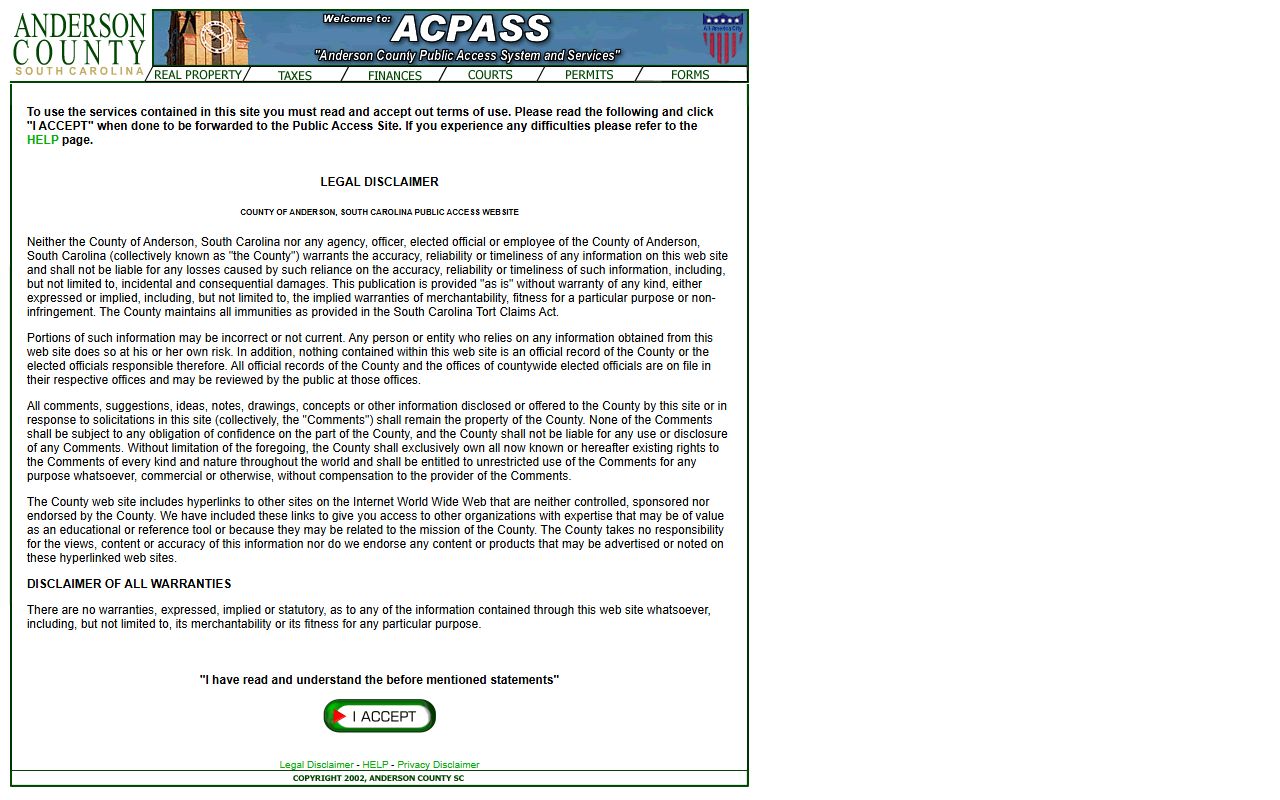
Use ACPASS as a county access channel, then verify court-file details through Public Index, Family Court, C-Track, or the Clerk of Court.
Anderson County Court Records Search Fields
The Public Index fields in Anderson County are built for either a narrow case-number lookup or a broader party search. The live Public Index requires browser access, so the research notes mark some options as partial, but the county and state sources support the core fields below. If a search fails, remove extra filters first. Public Index results must match all criteria entered, so too many filters can hide the correct Anderson County court record.
| Field Label | Type | Required | Notes / Format |
|---|---|---|---|
| County | Dropdown or county link | Yes | Select Anderson County from the statewide Case Records Search. |
| Court Type / Court | Dropdown | Unspecified | Circuit, Magistrate, and participating Municipal courts are available. |
| Case Number | Text | No | Use the exact case number for the narrowest search. |
| Party Name / Business Name | Text | No | Use names of parties or businesses when the case number is unknown. |
| Date Range | Date range | No | Narrows filing, action, or result dates. |
| Case Type / Subtype | Dropdown | No | Exact Anderson dropdown values were not accessible in plain fetch. |
| Action Type | Dropdown | No | Can help locate activity such as motions, judgments, or foreclosure entries. |
Types of Anderson County Court Records
Anderson County court records come from several court levels. Circuit Court is the general-jurisdiction trial court for South Carolina. In Anderson County, Circuit Court includes Court of Common Pleas civil cases and Court of General Sessions criminal cases. The Clerk of Court is the record custodian for those court files and also supports Family Court records. Magistrate and Municipal Courts keep many lower-level traffic, criminal, bond, warrant, and civil matters, while Probate Court keeps estate, guardianship, conservatorship, marriage-license, commitment, and settlement records.
Not all Anderson County court records carry the same public-access rights. Civil Common Pleas complaints, answers, motions, orders, judgments, and many foreclosure-related filings are generally public unless sealed or redacted. General Sessions criminal records may show indictments, charges, bonds, pleas, docket events, disposition, and sentencing orders. Family Court records can include divorce, custody, support, adoption, termination of parental rights, and juvenile matters, but public access is more limited. Probate material may be public for ordinary estates, while mental-health commitments and medical filings are not ordinary public lookup records.
- Circuit Court civil records cover Common Pleas filings, judgments, liens, and civil appeals from lower courts.
- General Sessions records cover felony and serious criminal proceedings after charges are filed in court.
- Magistrate records include county traffic, small claims, landlord-tenant, bond, preliminary hearings, and summary criminal matters.
- Municipal records include city police traffic, ordinance, bond, warrant, and criminal cases in participating cities.
- Family Court and Probate Court records use separate access rules because domestic, juvenile, estate, and medical interests may be involved.
For statewide appellate history, the C-Track Public Access system shows South Carolina Supreme Court and Court of Appeals events, basic case information, and many event-linked documents.
The manifest source for C-Track Public Access identifies the appellate system used when an Anderson County case moves beyond the trial court.
Trial-court results and appellate records are separate systems, so a full Anderson County court record search may require both channels.
What Anderson County Court Records Show
An Anderson County court record is more than a name result. Depending on the case type and court level, it may show the case number, court, county, court type, filing date, agency, party names, attorney names, judge, case type, docket actions, hearing dates, financial entries, and final disposition. Criminal records may also show charges, statute or citation references, offense date, arresting agency, bond type, bond amount, warrant number, plea, sentence, probation, and restitution when those items are publicly filed.
| Field | What It Shows |
|---|---|
| Case Number | The unique court file number used by the Clerk of Court, Public Index, or lower court. |
| Court / Court Type | Whether the matter is in Circuit, Family, Probate, Magistrate, Municipal, or appellate court. |
| Parties | Plaintiffs, defendants, petitioners, respondents, attorneys, and public addresses where allowed. |
| Docket / Actions | A chronological list of filings, service, motions, hearings, continuances, pleas, orders, and judgments. |
| Hearing Details | Date, time, roster, judge, courtroom, and related scheduling data when published. |
| Financials | Fines, assessments, costs, restitution, ticket payment status, judgment amount, or sale deposit entries. |
| Disposition | The outcome, such as judgment, dismissal, plea, conviction, sentence, or other closing action. |
Public Access for Anderson County Court Records
South Carolina access rules use more than one law. S.C. Code Section 30-4-30 gives a person the right to inspect, copy, or receive public records unless an exemption or other law applies. S.C. Code Section 30-4-40 lists exemptions, including law-enforcement and privacy-sensitive records. Judicial records also fall under Rule 610, SCACR, which governs requests for South Carolina Judicial Branch records and limits bulk or compiled judicial-record data for commercial purposes unless authorized.
For Anderson County court records, the practical rule is simple. Use Public Index, Court Roster Search, Family Court Public Portal, C-Track, or the Clerk of Court for judicial records. Use the Anderson County FOIA form for non-court county records, and use the Sheriff's FOIA channel for law-enforcement records such as booking reports or incident reports. The county FOIA form asks for the date, requester name, address, phone, email, a specific description of the information requested, and a signature. It lists the Anderson County Public Information Office mailing address, email, fax, and office phone.
Note: Court-copy and certification fees were not located in the official Anderson Clerk sources reviewed, so request costs should be confirmed with the Clerk.
The manifest source for Rule 610 judicial-record requests shows the state channel for court records that are not resolved through Public Index.
Rule 610 matters most when the request is for a court-maintained file, roster, administrative record, or compiled court data rather than a county administrative record.
The manifest source for the South Carolina FOIA statute supports the county public-records route for non-judicial records.
FOIA can help with county or sheriff records, but it does not replace the Clerk of Court for certified judicial files.
Restricted Anderson County Court Records
Public access is not unlimited. Juvenile court records are confidential under S.C. Code Section 63-19-2010 except by court order to persons with a legitimate interest and specific legal exceptions. Juvenile law-enforcement records are also confidential and kept separate from adult records under Section 63-19-2030. Adoption records are confidential unless a court orders otherwise. Sealed cases and expunged criminal records will not appear like ordinary public records.
South Carolina redaction rules also affect what a person sees in Anderson County court records. Rule 41.2, SCRCP requires redaction of personal identifiers such as Social Security numbers, taxpayer IDs, driver's license numbers, passport numbers, financial account numbers, PINs, passwords, minor identifiers, and certain home addresses. Beginning January 1, 2026, the Judicial Branch notes that home address information is no longer displayed on the public index for new or existing cases.
The manifest source for Rule 41.2 redaction requirements documents the privacy limits that apply even when an Anderson County court record is public.
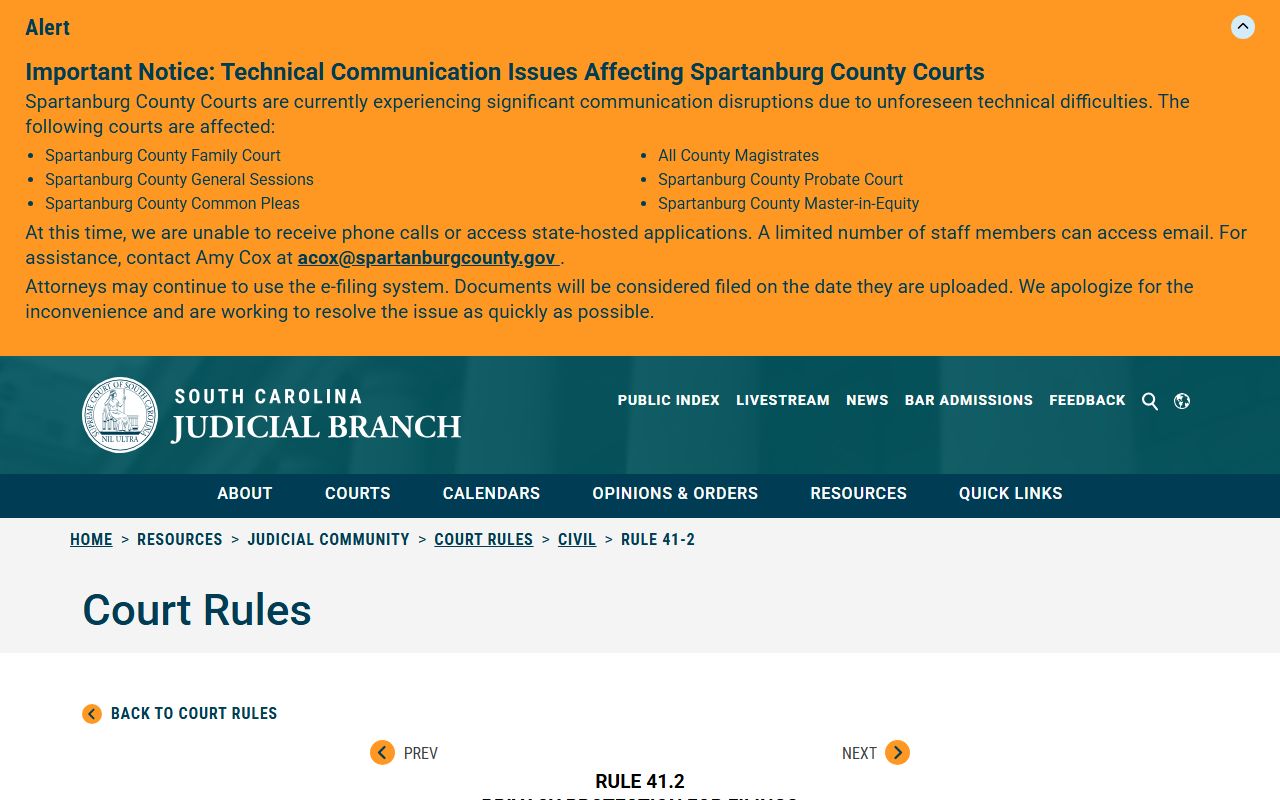
Redaction protects personal identifiers while leaving the public portions of the case file available through the proper court channel.
In-Person Anderson County Record Requests
Online court search is not the only access channel. Older files, certified copies, sealed-status questions, document-image gaps, and case-specific record questions should go to the Anderson County Clerk of Court. The Clerk is the record custodian for General Sessions criminal, Common Pleas civil, and Family Court proceedings. For Summary Court traffic, small claims, landlord-tenant, bond, preliminary hearing, and county misdemeanor matters, the Anderson County Summary Court and Central Traffic Court may be the better office. City traffic and criminal cases may need the Municipal Court that heard the charge.
Anderson County Clerk of Court
100 South Main Street
Anderson, SC 29624
Mailing: PO Box 8002, Anderson, SC 29622
(864) 260-4053
Monday-Friday, 8:30 a.m.-5:00 p.m.
Written requests should identify the case number, party names, case type, document requested, certification need, return address, and phone or email. For criminal case detail, the Anderson County criminal court records page separates the full case file from arrest and booking material.